

Intelligent manufacturing requires connected systems
Industrial production is changing. Companies increasingly need to coordinate complex manufacturing networks, connect different IT systems, and make information available across multiple production sites.
Particularly in globally distributed production processes, challenges arise: information must be exchanged reliably, processes coordinated, and decisions made as efficiently as possible.
Artificial intelligence offers new possibilities to examine these challenges and develop intelligent control concepts.
This is the focus of research at the University of Potsdam. The research work centers on artificial neural networks (ANN) and their use in optimizing distributed manufacturing processes.
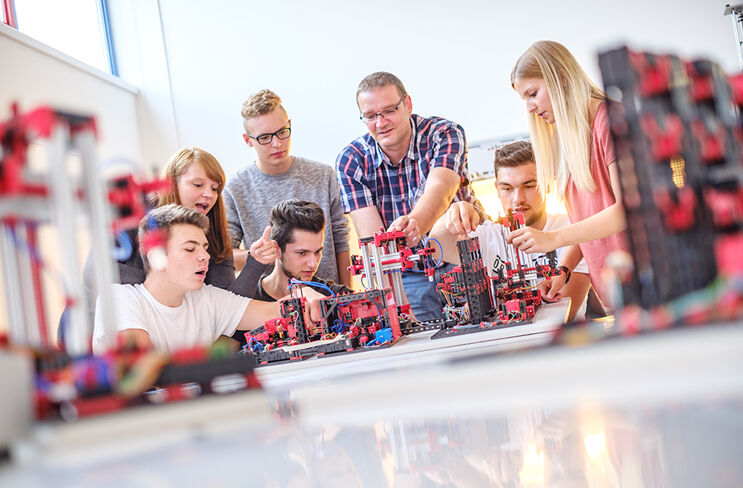
fischertechnik Learning Factory 4.0: Realistic Simulation of Industrial Production Processes
The University of Potsdam uses the fischertechnik Learning Factory 4.0 for its research work.
The modular production model physically represents industrial manufacturing processes and enables individual process steps to be practically traced. In combination with digital simulation technologies, complex production scenarios can be examined.
The particular added value lies in the connection between the physical and digital worlds: production processes are not only theoretically modeled but can also be illustrated and analyzed using a real plant model.
This makes the Learning Factory a suitable research environment to practically investigate questions related to automation, intelligent production control, and Industry 4.0.
A Concrete Research Scenario: Jam Production at Four Locations
How does intelligent control of distributed production systems work in practice?
The University of Potsdam investigates this question using an illustrative scenario: the production of jam at four globally distributed production sites.
The individual sites have different IT systems but still need to collaborate within a common production network.
The fischertechnik Learning Factory 4.0 represents one of the four production stations. The modeled manufacturing process includes several consecutive steps:
• Storage and provision of the fruit
• Supply of raw materials to the cooking machine
• Production of the jam
• Filling into jars
• Provision of the finished products
This example illustrates how complex the coordination of even comparatively simple production processes can become when multiple locations and different IT systems are involved.
The simulation allows the investigation of information flows and process interrelationships. The goal is to identify weaknesses and develop possibilities for better coordination of the production sites.
Artificial Neural Networks as the Key to Intelligent Manufacturing Control
A central component of the research approach is the use of artificial neural networks.
These machine learning methods can analyze data, recognize patterns, and map complex relationships. In industrial manufacturing, they open up new possibilities for analyzing and optimizing production processes.
The research project at the University of Potsdam focuses in particular on how neural networks can support the coordination of distributed production systems.
An important subject of investigation is inefficient information and knowledge flows between individual locations. When information is not passed on in a timely or complete manner, it can complicate the coordination of production processes.
The simulation makes it possible to systematically examine such relationships and compare different control and management approaches.
Not only technical issues are the focus here. Organizational measures to improve collaboration between production sites are also considered.
Digital Twin and Physical Learning Factory Connect Real and Virtual Production Worlds
Another special feature of the research approach is the connection of the physical fischertechnik learning factory with digital simulations and a neural twin.
While the real model vividly represents the manufacturing processes, digital methods can be used to map complex relationships and examine various scenarios.
This creates a research environment in which industrial processes can be viewed from different perspectives.
The combination of physical model factory, digital simulation, and artificial intelligence is particularly interesting for research on intelligent production systems. It enables the joint analysis of technical and organizational relationships.
What research means for Industry 4.0
The research work at the University of Potsdam makes it clear that intelligent production control goes far beyond the automation of individual machines.
What is crucial is rather the interaction of different production sites, IT systems, and information processes.
The study of distributed neural networks opens up new possibilities to identify information losses and inefficiencies. The simulations also allow management interventions to be derived that can support better coordination of the involved production systems.
Another important step is to empirically verify the developed approaches in real production environments and under real-time conditions in the future.
Thus, the research project contributes to the scientific examination of the possibilities of artificial intelligence in industrial manufacturing.
fischertechnik as a partner for industrial research and higher education
The application at the University of Potsdam shows how the fischertechnik Lernfabrik 4.0 can be used for scientific questions around Industry 4.0, automation, and artificial intelligence.
The system makes it possible to realistically represent industrial production processes and connect them with digital technologies.
This creates diverse application possibilities for universities and research institutions: from teaching automated manufacturing processes to studying networked production systems to researching intelligent control concepts.
For companies as well, the combination of a physical model factory and digital simulations offers interesting perspectives. New technologies and production concepts can first be examined and illustrated in a controlled model environment.
Conclusion: The future of production is networked and intelligent. The University of Potsdam demonstrates with its research approach how artificial neural networks, digital simulations, and the fischertechnik Lernfabrik 4.0 can work together to gain new insights for production control. The connection of theory and practice creates an important foundation to scientifically explore the potentials of Industry 4.0 and further develop future production systems.