- About fischer
- group of companies
- Sustainability
- Newsroom
- Spotlights
- Career

- Home
- Spotlights
- Securely install sun sails and awnings

As soon as temperatures rise, life increasingly moves outdoors. The terrace and garden quickly become an extended living area – provided there is effective sun protection. Sun sails and awnings provide pleasant shade and protect against heat, glaring sunlight, and prying eyes. At the same time, they offer security during sudden weather changes. With the right installation, sun sails and awnings can be mounted quickly, securely, and permanently.
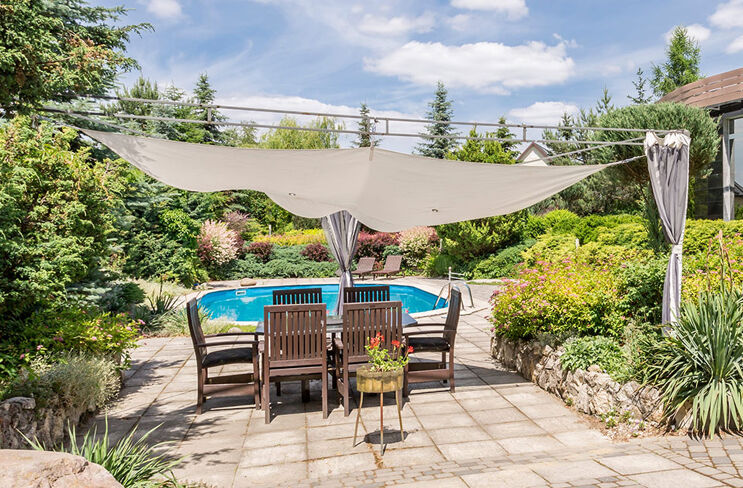
Sun sails appear light and airy but place high demands on the fastening. Especially with large sail surfaces, significant forces arise from the wind that must be safely absorbed. A wind-protected location is therefore recommended. Equally important for functionality: a tilt angle of around 30 degrees so that rainwater can reliably drain off and no water pockets form.
Sun sails can be mounted in many ways – for example, on house walls, railings, roof rafters, or freestanding masts. Anchor and angle plates with eyelets ensure secure attachment to the building. Alternatively, slightly inclined, concreted masts with ring eyelets provide stable and durable mounting points in the garden or on the terrace. Retrofitting on existing foundations and concrete surfaces is also easily possible – for example, with bolt anchors or concrete screws made of stainless steel.
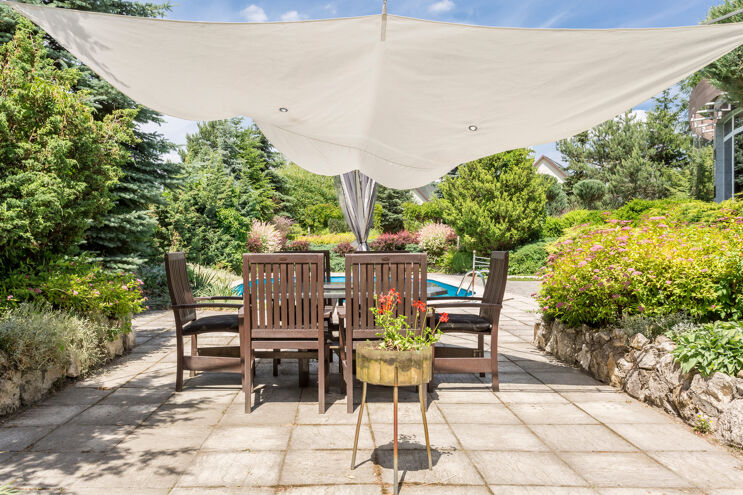
For wall mounting, heavy-duty fastenings such as bolt anchors in concrete or injection systems in masonry are used. Particularly versatile is an injection mortar like the fischer FIS V Plus, which, in combination with suitable steel components, is suitable for almost all mineral substrates. For wooden constructions such as rafters or beams, stainless steel wood screws ensure a secure and durable connection. The sun sail is fastened via its existing corner points with rings or webbing loops, which are connected to the fastening points – for this, for example, carabiner hooks or tensioning locks can be used.
Suitable systems are also available for special substrates – such as spacer mounting systems for external thermal insulation composite systems (ETICS) or through-rod anchor sleeves for cavity masonry. The basic rule is: for a durable and secure installation, only fastening elements made of stainless steel should be used.
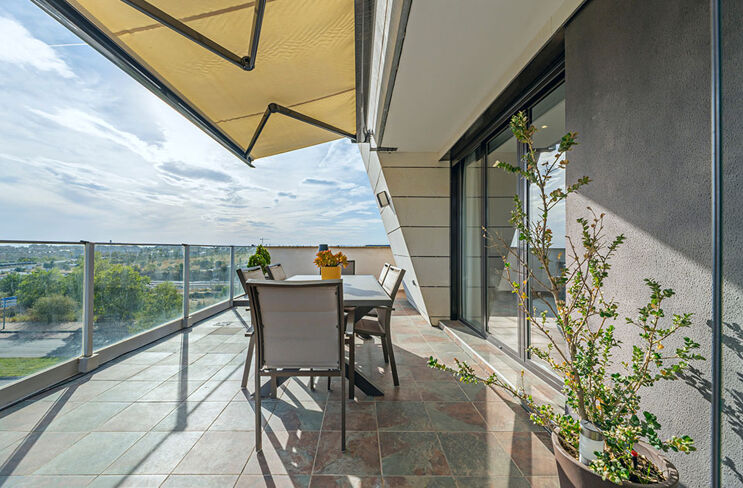
Compared to other shading systems, awnings are significantly more robust and count among the real heavyweights in sun protection for terraces and balconies. They are firmly anchored to the supporting substrate via stable brackets that securely hold the support tube or cassette.
Due to the high dead weight, usually between 40 and 80 kilograms, as well as additional wind loads, considerable forces act on the fastening points. Accordingly, the requirements for mounting systems are very strict. These are clearly defined, among others, in DIN EN 13561 and the BKTex guideline. For large awnings, immense tensile loads of over 1,000 N (≈100 kilograms) per fastening point quickly act in addition to the high transverse loads from the dead weight. Reliable solutions such as steel anchors in concrete or injection systems in masonry are therefore all the more important. They ensure secure load transfer and protect the building and awning from damage in the long term.
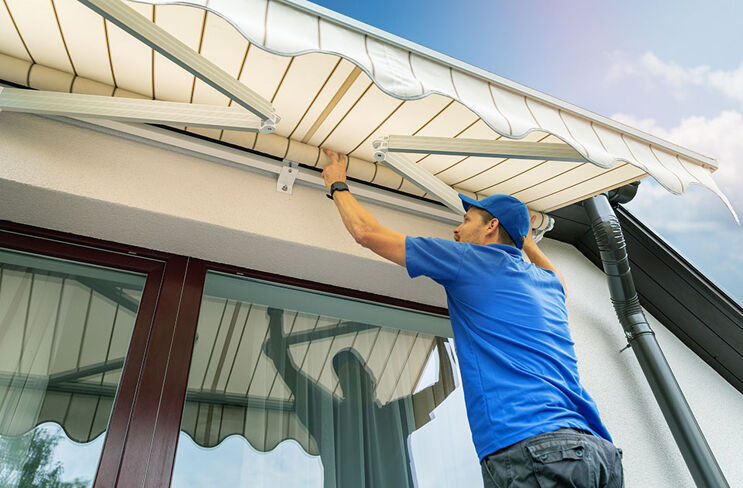
Properly installing sun sails and awnings lays the foundation for a relaxed summer in your own outdoor area. Terrace and garden become a comfortable feel-good zone with reliable sun protection in spring and summer. Sun sails and awnings not only provide pleasant shade but also protect against weather changes and curious glances. With the right fastening technology, the outdoor season at home becomes significantly more comfortable, safer, and more durable.