Protection against earthquakes

Innovation for earthquake-resistant retrofitting

Protection against earthquakes
Earthquakes represent one of the greatest challenges for structures worldwide. Existing buildings, especially those constructed before the introduction of modern earthquake standards, are particularly vulnerable. Many of these constructions are inadequately designed to withstand vibrations and can suffer significant damage or fail under seismic stress. How can existing structures be effectively retrofitted against earthquakes? The fastening specialist fischer, together with Purdue University (USA), dedicated a joint research project to this question. Tests on full-scale reinforced concrete structures were conducted to explore and validate new possibilities for seismic retrofitting.

A dynamic system with risks

Our planet is in constant motion. Approximately 500,000 earthquakes are recorded worldwide each year (Source: U.S. Geological Survey (USGS)). Regions along the Pacific Ring of Fire, in the Himalayan region, the Mediterranean area, Central America, and the Caribbean are particularly exposed – all areas with high tectonic activity. In addition to natural geological processes, human interventions such as oil and gas extraction, fracking, geothermal drilling, or the construction of large reservoirs can also trigger seismic activities. For planners and engineers, this means a complex challenge: not only must the main structure of the building be designed safely, but non-load-bearing components such as facade elements, installations, suspended ceilings, or technical systems must also be protected against earthquake effects. The existing building stock remains particularly critical: numerous structures were built before seismic standards were established and are potentially insufficiently protected today.
 
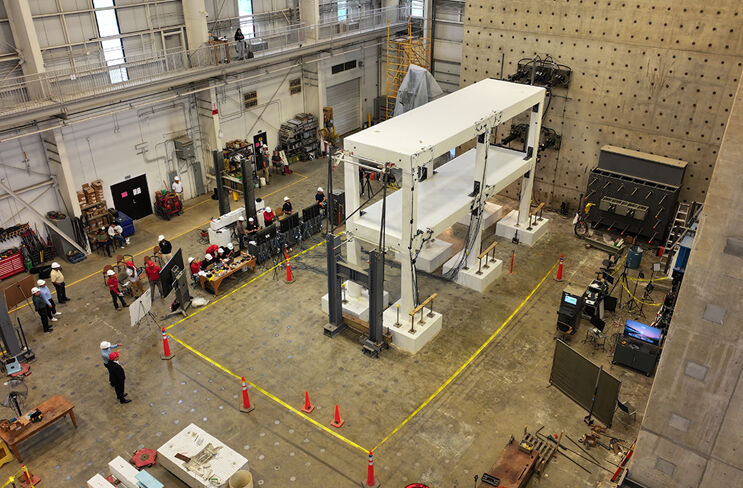
Large-scale earthquake research: fischer and Purdue University tested a new solution for reinforcing vulnerable reinforced concrete structures on original buildings. @fischer

Full-scale earthquake tests at a 1:1 scale

As part of the cooperation, the fischer group of companies and one of its partner universities, Purdue University in the USA, conducted experimental investigations on reinforced concrete load-bearing structures in full size. The focus was on the connections between beams and columns – so-called frame joints – which are particularly stressed during earthquakes. At the same time, they are considered potential weak points in the overall system of a structure. “These joints in structures are subjected to particularly high stresses and large forces during horizontal loading in an earthquake,” says Dr. Margaritis Tonidis, former doctoral candidate at Purdue University and lead project engineer for the project. If such a joint fails, it can lead to the collapse of the entire system
 

Innovative Reinforcement of Critical Nodes

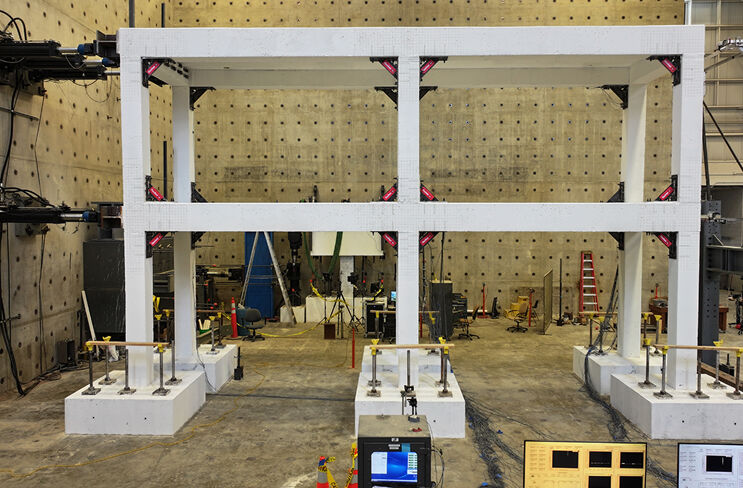
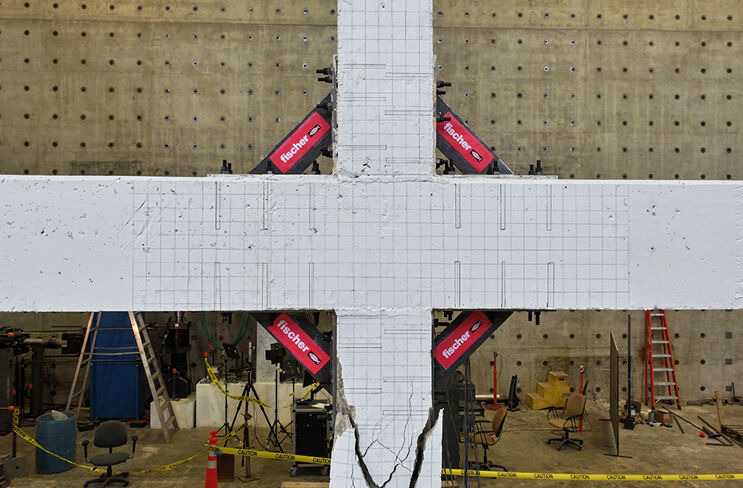
A system of composite anchors and Vierendeel elements was investigated for the subsequent reinforcement of frame joints. An injection mortar from the fischer group of companies was used in combination with threaded rods. The reinforcement solution modifies the force flow between beam and column. Load effects are transferred from the joint area to adjacent components. Defined failure mechanisms prevent the system from complete collapse. “Even under high seismic demands, the injection mortar proved to be a reliable adhesive connection for subsequent reinforcements and led to groundbreaking results in the tests,” emphasizes Prof. Akanshu Sharma, Associate Professor at Purdue University and former endowed professor at the Institute of Materials Science at the University of Stuttgart. In comparison, the unreinforced system showed significant damage in the joint areas under seismic load, while the reinforced variant exhibited clearly improved load-bearing behavior. He further emphasizes: “The fischer composite anchor system can also be installed during building use without causing major interruptions.”

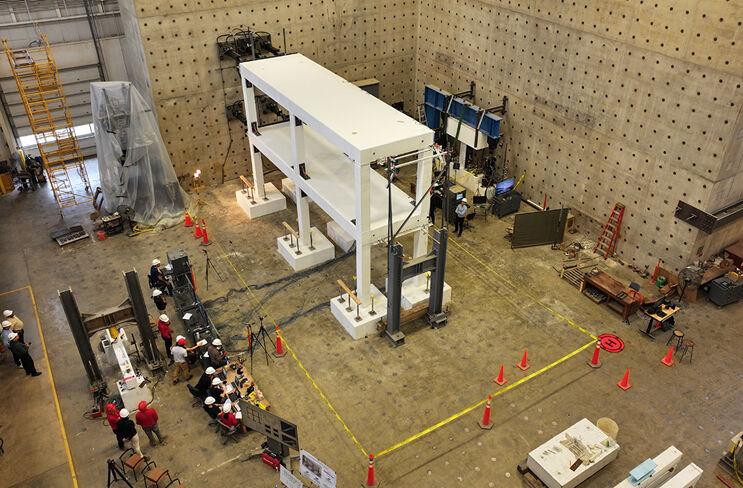
Safe retrofitting in focus: Based on large-scale earthquake tests, fischer and Purdue University validated a method for reinforcing critical joints in reinforced concrete structures. @fischer
Even under high seismic requirements, the injection mortar proved to be a reliable adhesive connection for subsequent reinforcements and led to groundbreaking results in the tests.
Prof. Akanshu Sharma, Associate Professor at Purdue University and former endowed professor at the Institute for Materials Science at the University of Stuttgart.

Research under realistic conditions

“The project was a great and unique opportunity to review and test the results and concepts we gained in our previous research under realistic conditions,” emphasizes Dr. Erik Johannes Stehle, Head of Development FiXperience at fischer. “It became clear once again: The success of such a seismic reinforcement solution depends to a large extent on the performance of the anchoring – here the composite anchor system was able to impress both at the structural level and within the beam-column connections with high stiffness and low deformations at high load levels.”
 
New support for existing buildings in earthquake-prone regions: In joint large-scale tests, fischer and Purdue University demonstrated how existing reinforced concrete structures can be specifically retrofitted against earthquakes. @fischer
The success of such a seismic reinforcement solution depends to a large extent on the performance of the anchoring - here the bonded anchor system was able to convince.
Dr. Erik Johannes Stehle, Head of Development FiXperience at fischer

International Collaboration as a Driver of Innovation

Dr. Erik Stehle emphasizes: „We need international research collaborations. Through exchange with each other, we gain inspiration, ideas, and impulses for new innovations – and strengthen our position as a global innovator.“ Prof. Sharma adds: „At Purdue University, we are very proud to have already conducted several groundbreaking research projects with the fischer group – including the world’s first seismic testing of full-scale structures with a subsequent reinforcement solution for frame joints using Vouté elements.“
More stability when the earth shakes: In joint large-scale tests, fischer and Purdue University have tested a solution that allows existing reinforced concrete structures to be specifically strengthened for earthquakes. @fischer
At Purdue University, we are very proud to have already conducted several groundbreaking research projects with the fischer group of companies.
Prof. Akanshu Sharma

Outlook: From Research Results to Application

The scientifically confirmed findings are now to be transferred into practical implementation in existing buildings.
They show that there are realistic and economically feasible ways to make existing buildings significantly more resistant to earthquakes – thereby protecting human lives and securing infrastructure in the event of an emergency.
 
cd-blue-7fd6df45cb-t5xs5